
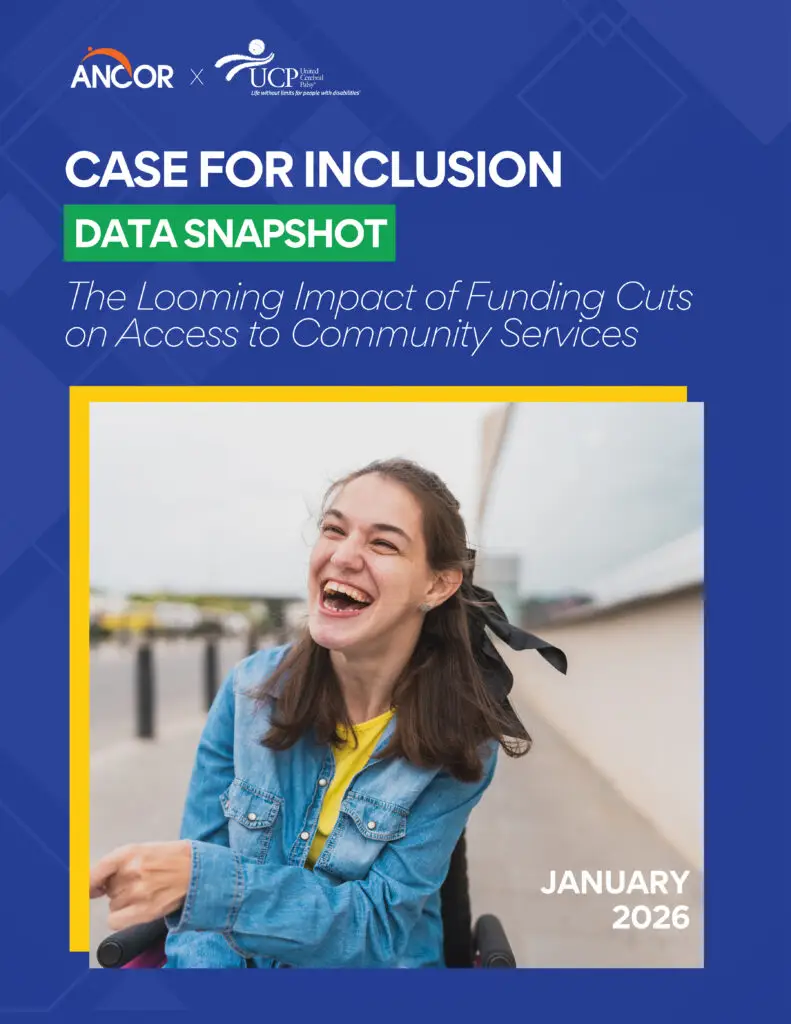
Today, United Cerebral Palsy (UCP) and ANCOR, two of the leading national voices for providers of long-term support services for people with intellectual and developmental disabilities (IDD), released the latest Case for Inclusion Data Snapshot. The findings show modest but meaningful improvements in the workforce that supports people with IDD, alongside new federal policy changes that could jeopardize that progress.
The report reveals that wages for direct support professionals (DSPs), the workers who support people with IDD in their homes and communities, rose to a national average of $17.20 per hour in 2023, while workforce turnover declined to 39.7 percent — the first time turnover has fallen below 40 percent since national data collection began in 2014. Job vacancy rates also improved, with full-time vacancies dropping to 12.2 percent and part-time vacancies to 14.6 percent.
Much of this progress was driven by $26.3 billion in temporary recruitment and retention investments made available through the American Rescue Plan Act (ARPA). Yet despite the modest gains, DSP wages continue to fall short of living wage benchmarks in every state, and disability service providers across the country continue to report staffing challenges that limit their ability to expand, or even maintain existing services.
Due to inadequate Medicaid reimbursement rates, providers struggle to pay wages that compete for talent against hourly wage industries such as fast food and retail, and as a result, there are too few DSPs to deliver the supports on which people rely.
These dynamics contribute to the fact that in 2025, separate research from ANCOR found that 88 percent of providers reported experiencing moderate or severe staffing challenges. As a result, 62 percent of providers reported turning away new referrals, while 29 percent reported discontinuing programs and services due to insufficient staffing.
At the same time, services in which people are supported in their homes and communities — known as home- and community-based services, or HCBS — remain the most cost-effective model for accessing long-term care for people with IDD. The new Case for Inclusion Data Snapshot shows that 94 percent of people with IDD receiving Medicaid-funded services do so through HCBS, costing on average just 44% of what it costs to support people in institutional settings such as nursing homes ($49,723 vs. $111,325 per capita annually, respectively).

However, the previous expiration of ARPA funding, combined with the forthcoming enactment of the 2025 budget reconciliation package that included nearly $1 trillion in cuts to federal Medicaid funding, present new risks for IDD services. Because federal statute does not require states to offer HCBS within their Medicaid programs, states facing budget shortfalls may scale back HCBS offerings to close the gap. This comes as 552,339 people with IDD are on their state’s waiting or interest list for services, an 8 percent increase since 2024.
ANCOR and UCP’s new report concludes with policy recommendations for state and federal leaders, including establishing a federal occupational classification for DSPs, strengthening Medicaid funding for HCBS, and improving oversight of reimbursement rates.
“People with IDD and their families will be profoundly impacted if we continue down the dangerous path of failing to sufficiently invest in home- and community-based services and the workforce of direct support professionals who make their inclusion in the community possible,” said Barbara Merrill, ANCOR’s chief executive officer. “We are finally seeing modest improvements in recruitment and retention of this critical workforce — gains that were only possible thanks to targeted but time-limited investments by federal and state governments.”
“Without sustained funding, we risk reversing the fragile progress we’ve fought so hard for over the past several years,” said Diane Wilush, interim president and CEO for UCP. “With post-pandemic resources drying up and massive federal Medicaid funding cuts on the horizon, it’s hard to imagine how the trajectory we’re on doesn’t lead to a mass exodus of direct support professionals from the workforce — leaving hundreds of thousands more people with IDD without the vital supports needed to stay connected to and included within their communities.”
To download the new Case for Inclusion Data Snapshot and browse state-by-state data for dozens of measures assessing how well state programs are supporting people with IDD to be included in their communities, visit CaseForInclusion.org.
About ANCOR
A leading national association of community-based providers, ANCOR has advocated relentlessly for person-centered outcomes for people with intellectual and developmental disabilities since 1970. As the trusted conduit of resources for providers, policymakers and the public, ANCOR enhances providers’ ability to support individuals with I/DD to be fully included and empowered in their communities.
About United Cerebral Palsy
United Cerebral Palsy (UCP) was founded in 1949, and today, its network of affiliate organizations in the United States and Canada provides a wide range of services annually to approximately 200,000 children and adults with cerebral palsy and other disabilities. These services include information, resource referral, advocacy, research, educational instruction, early intervention, therapies, job coaching, integrated employment, home and community-based services, recreational opportunities, and housing assistance. UCP is committed to the mission that all people with disabilities should be treated as equal members of an inclusive society.